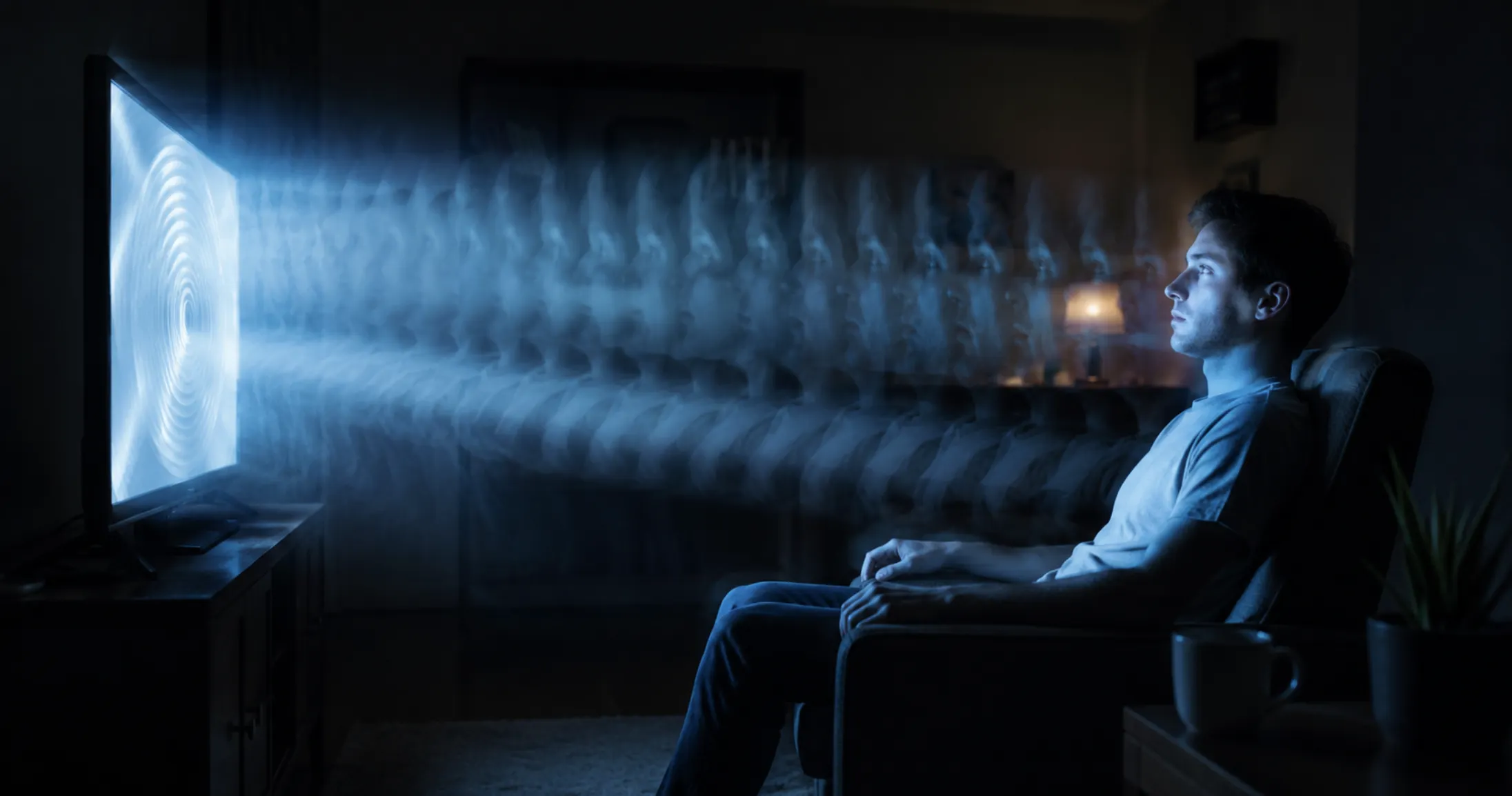
I want to talk about something most people are not willing to hear, because most people are not willing to give it up. Television. Specifically: what happens to your brain when you watch it, why it is more dangerous than you think, and why the most disciplined, high-performing people I have studied treat it with the same seriousness they would treat any other addiction.
This is not a moral argument as I have no interest in telling you what is acceptable or not. You have free will and you have the choice. What I do have is a deep interest in the mechanics of the mind — in understanding how the subconscious is shaped, who shapes it, and whether that process is happening with your knowledge and consent or without it.
When I understood what television actually does to the brain, the choice to turn it off became obvious, and I want to give you that same clarity.
The 12-Minute Threshold
Here is what the research shows: within approximately 12 to 15 minutes of watching television, the brain enters a state of alpha wave activity. Alpha is the same brain state associated with light meditation, hypnagogic drowsiness, and — critically — heightened suggestibility.
In this state, the analytical, critical mind — the part that evaluates, questions, and filters incoming information — goes quiet. The subconscious, which accepts rather than evaluates, becomes primary. You are, in the clinical sense of the word, mildly hypnotized.
This is not a coincidence. The medium was understood from its earliest days to have this effect. The flicker rate of the screen, the passive reception posture, the sustained visual attention — all of it conspires to soften the guard, and once that guard is soft, what gets through goes deep.
"Some of the best advice I ever received was observe the masses and do the opposite."
— Matt Grybel, FounderProgramming Is Not Metaphor
The word is not an accident, television programs you. The shows are called programs because the people who create them understand, at a sophisticated level, how to move an audience through emotional states, how to embed beliefs, how to make a lifestyle look aspirational or a behavior look normal.
The commercials that interrupt those programs are designed with the same precision. They are not simply informing you about a product, they are associating that product with an emotional state — security, attractiveness, belonging, relief — and delivering that association directly to a subconscious that, 12 minutes in, is no longer defending itself. You can even notice the commercial volume is 10-15% louder than the actual show because in the event you leave the room to grab a drink or snack, your subconscious mind can ‘still hear’ the commercial.
Repeat this across thousands of hours over years and decades, and you begin to understand why so many people carry beliefs about money, relationships, their own bodies, and their own potential that they never consciously chose. They were given to them, often times, through the television programming. “Tell-a-vision”.
The Binge Pattern
Modern streaming has introduced a new variable that the older research did not fully account for: binge-watching. The autoplay mechanism, the cliffhanger episode ending, the friction-free next-episode button — these are not user conveniences — they are retention engineering.
The binge pattern activates the same dopamine loop as any other compulsive behavior. Watch long enough and the brain begins to crave the passive stimulation the way it craves any other substance. You are not relaxing, you are sedated. And the distinction matters enormously.
Relaxation restores — it brings the nervous system down, quiets the mind, builds capacity. Whereas sedation numbs — it suspends awareness without restoring anything. When you emerge from 4 hours of streaming, you have not rested. You have simply not been present.
"Sedation is not rest. One restores you while the other just delays you."
— Matt Grybel, FounderYour Brain Is Sacred
I want to offer you a reframe that changed how I relate to this entirely: your brain is the most sacred, sensitive, and powerful instrument you will ever possess. What you feed it is not a casual choice.
We are meticulous about what we put in our bodies — or at least we know we should be. We understand that processed food, consumed habitually, degrades physical health. The parallel for the mind is exact. Processed media — designed to stimulate, agitate, and sell — consumed habitually, degrades mental sovereignty. It erodes the clarity and self-directedness that everything else in your life depends on.
The news deserves its own mention. News programming, in particular, is constructed around the emotional register of threat and crisis. The brain is wired to pay disproportionate attention to potential danger. It does not serve you well in front of a screen designed to exploit that wiring. A steady diet of news does not make you more informed. It makes you more anxious, more reactive, and less able to think clearly about the actual circumstances of your own life.
What to Replace It With
I am not asking you to live in deprivation, I am asking you to make intentional decisions.
The single highest-leverage replacement for passive screen consumption is physical movement. Walk. Run. Lift. Move in a way that requires your body to be present. Physical activity does not just improve health — it actively generates the neurological conditions for better thinking, better mood, and better access to the subconscious insight that most people are trying to reach through other, slower means.
Beyond movement: read. Not flip through pages, but actually read. Engage with ideas that require your active attention. Listen to audio that is building something in you, not simply entertaining you. Have real meaningful conversations, cook a meal or even sit in silence long enough to hear what your own mind is saying when no one else is talking at it.
These are not sacrifices, they are upgrades. But they require you to create the vacancy first — and the first step is recognizing what is filling the space that those things deserve.
The 30-Day Experiment
Here is what I invite you to consider: a 30-day television and streaming detox. Not permanent — though for some people, permanent becomes obvious — just 30 days.
30 days is not a coincidence, it is the minimum threshold for a habit to begin restructuring at the neurological level. 30 days of not reaching for the remote, not opening the app, not surrendering the evening to someone else's content — and watching what fills that space instead.
Most people who complete this report the same things: the first week is restless and uncomfortable. The second week, a quietness begins to settle. By week 3, the clarity is striking. By the end of 30 days, many people describe feeling like they have gotten some essential part of themselves back — a self they had not realized was missing.
That self — the one who thinks clearly, who has ideas, who is present in their own life — was always there. It was simply waiting for the noise to stop.
Go Deeper
The morning ritual is the entry point. The Élevée programs take it further — structured transformation built around the same principles, applied with precision over thirty days.
Explore the Programs →